
Browser game · AI dialogue
The Last Dinner
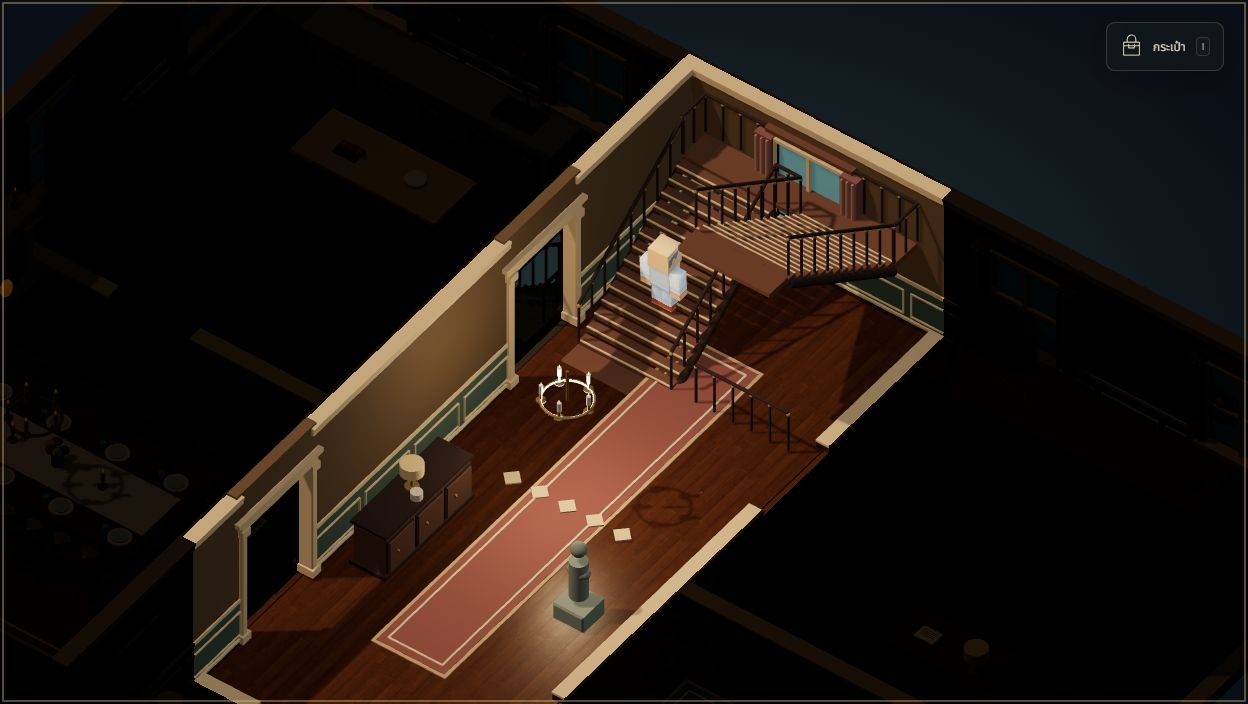
A haunted mansion remembers a massacre. Walk its rooms, enter six witnesses’ memories and reconstruct what happened.
Personal · Solo · Built with Codex
My contribution
I designed the story, puzzles and endings, directed Codex (an AI coding agent) through the build, then tested and shipped it on AWS.
- A complete investigation in Thai and English: 14 rooms over three floors, six residents, 14 pieces of evidence and three endings.
- NPC dialogue through Amazon Bedrock inside story guardrails, with authored replies as a fallback. In the final model test, Claude Sonnet 4.5 answered all 54 provider calls with no canon-filter failures.
- Serverless AWS delivery: S3 and CloudFront, a Lambda dialogue API and DynamoDB quotas.
Try it
See what it can do
Personal project · October 2026 · built in a one-day sprint
What this project does
You arrive with a tape, a key and a list of names. Show evidence to the residents, step into their memories, spot contradictions and rebuild the last dinner, then decide what leaves the house.
Inside the project
- Walk the investigator with WASD; E talks or inspects; the case notebook, evidence and map live in the bag.
- Puzzle rules and evidence stay deterministic in JavaScript; the AI can talk but cannot unlock progress.
- Five models were compared on 72–90 scripted dialogue cases before choosing Claude Sonnet 4.5.
- A happy-path test earns every clue through the real rules, alongside checks for navigation, sound and delivery.
Skills & practical experience
Designing a solvable mystery around deterministic state, keeping an LLM inside story boundaries, and shipping a serverless game with tests.
- Three.js
- JavaScript
- Game design
- AWS Bedrock
- AWS Lambda
- Automated testing
From the public repository: code, tests, story documents, model-evaluation records and asset credits. Original code is MIT licensed.
Project context
The story deals with murder and coercion without graphic gore. The demo is a one-room slice built from the game’s own code.