
Research · Brain biometrics
EEG-BBNet
Can brain signals identify a person? A 2022 preprint on recognising people from EEG with graph neural networks.
Research · 9 authors · Co-author
My contribution
Co-author, 5th of 9, while a student at Kamnoetvidya Science Academy (KVIS), in research led by the BRAIN Lab at VISTEC. The paper does not split tasks between authors.
- Before the paper: my YSC 2020 project with Korn Surapat, person authentication from EEG — preprocessing, electrode-distance graphs and a GCN classifier in TensorFlow and Spektral, trained on day 1 and tested on day 2.
- Named on arXiv:2208.08901 (August 2022) with KVIS affiliation.
Try it
See what it can do
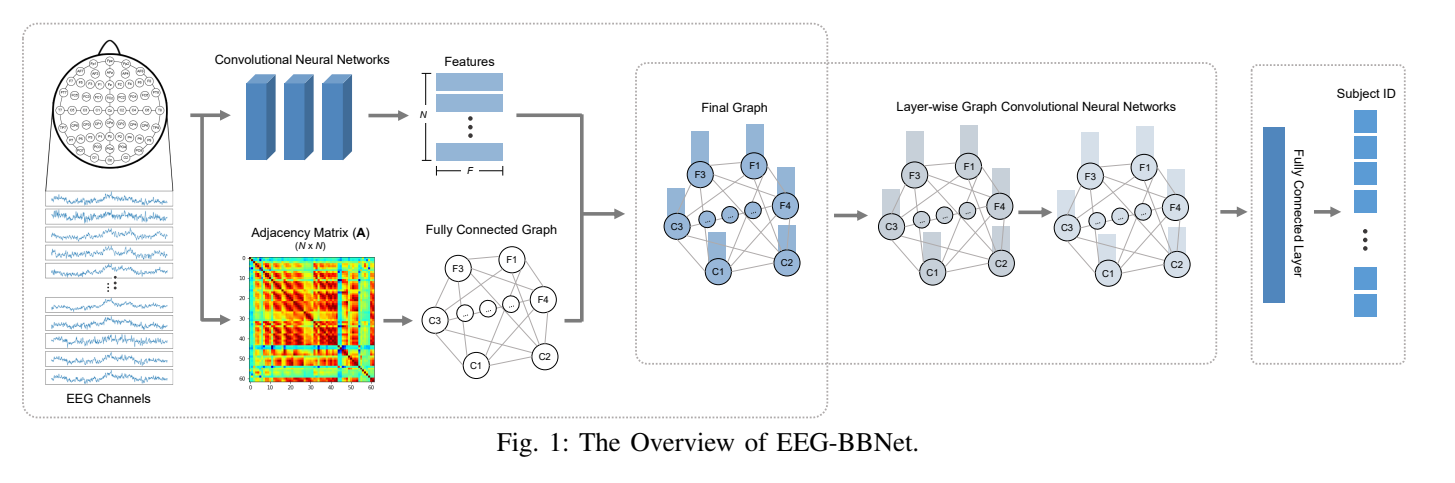
VISTEC BRAIN Lab collaboration · co-authored as a KVIS student · arXiv 2022
What this project does
EEG-BBNet combines convolutional EEG features with graphs of how electrodes relate, then classifies who the person is. It was tested on OpenBMI recordings of 54 people across motor imagery, ERP and SSVEP tasks.
Inside the project
- Compares five ways to build the electrode graph across the three EEG tasks.
- Tests cheaper headsets by keeping only the Emotiv EPOC+ or OpenBCI electrode positions.
- Tested on a second recording day, accuracy drops sharply; adding 10% of that day’s data to training brings it back to almost 80%.
Skills & practical experience
Biosignal preprocessing, graph neural networks and honest evaluation across sessions.
- EEG signal processing
- Graph neural networks
- TensorFlow
- Spektral (GCN)
- Brain biometrics
- Research collaboration
Co-authorship from the arXiv v1 author list. The YSC 2020 notebook is in my private repository; it records no accuracy, so none is claimed.
Project context
Research led by VISTEC’s BRAIN Lab with KMITL and Tokyo Tech; I took part as one of two KVIS students.
Signals → connections → identity
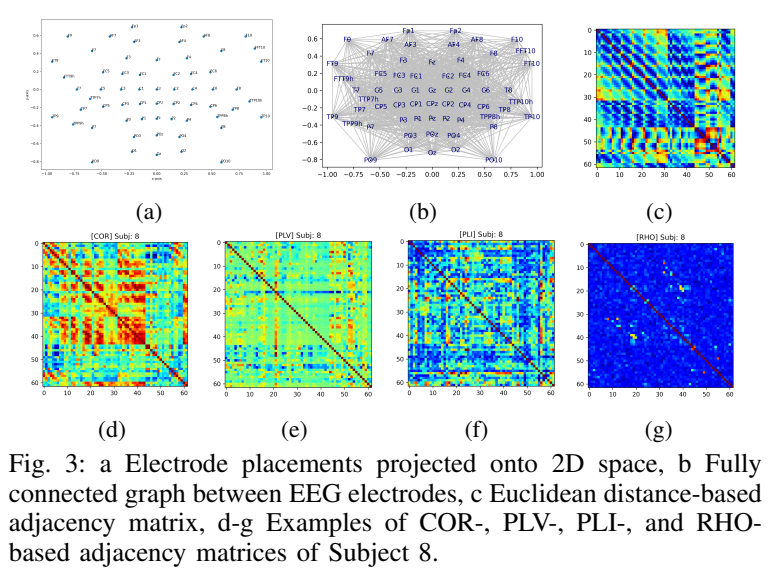
Motor imagery, event-related potentials (ERP) and steady-state visual evoked potentials (SSVEP) provide three evaluation settings. Connectivity measures describe how EEG channels relate.
ERP, session I, Pearson correlation connectivity. Correct recognition rate: mean ± standard deviation across five folds.
Across-day performance drops without fine-tuning; these controlled results do not establish real-world biometric reliability.
This showcase covers the 2022 preprint. The later IEEE Sensors Letters article has a revised author list that does not include Ratha.
Figures reproduced without modification from Lakhan et al., arXiv:2208.08901v1 · CC BY-NC-ND 4.0.